Ya sea que estés integrando sensores en una boya marina, actualizando pantallas LED para exteriores o simplemente instalando el cableado de una bomba para un estanque de jardín, hay algo seguro: el agua y la electricidad no se mezclan. Ahí es donde los conectores impermeables demuestran su utilidad. Pero cuando consultas una hoja de datos y ves “IP67” en una opción y “IP68” en otra, la diferencia puede parecer poco clara. Ambos parecen estar perfectamente sellados. Ambos prometen protección contra los elementos. Entonces, ¿cuál se adapta realmente a tu proyecto?
En esta guía, te explicaremos qué significan realmente IP67 e IP68, dónde destaca cada clasificación y cómo tomar una decisión con confianza, ya seas un ingeniero de compras que especifica miles de unidades o un aficionado que construye algo que simplemente debe durar al aire libre.
Comprendiendo las clasificaciones IP: una introducción rápida
Antes de comparar números, es útil saber qué estamos midiendo. Una clasificación IP (protección contra la entrada), definida por IEC 60529, indica qué tan bien una carcasa resiste partículas sólidas y líquidos. El primer dígito cubre el polvo (6 significa completamente hermética al polvo), mientras que el segundo dígito cubre el agua.
Tanto los conectores IP67 como los IP68 comienzan con un “6”, por lo que son igualmente impermeables al polvo. La verdadera diferencia está en ese segundo dígito y en las condiciones de prueba que eligen los fabricantes.
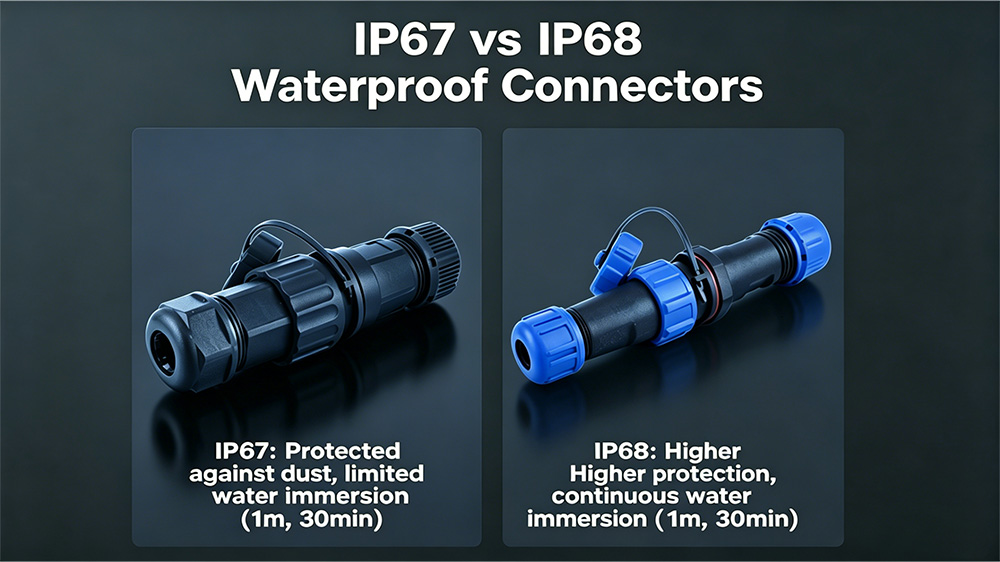
IP67 significa que el conector puede sumergirse en 1 metro de agua durante 30 minutos sin una entrada perjudicial. Esta es una prueba de laboratorio estandarizada y repetible.
IP68 significa que el conector supera a IP67, pero las condiciones exactas (profundidad y duración) las define el fabricante. Un conector IP68 podría probarse a 2 metros durante una hora; otro podría soportar 10 metros durante 24 horas. No existe un punto de referencia universal.
Ese único hecho es lo más importante que debes recordar: IP68 no es simplemente “mejor” en términos generales. Es una promesa que debe leerse en la letra pequeña.
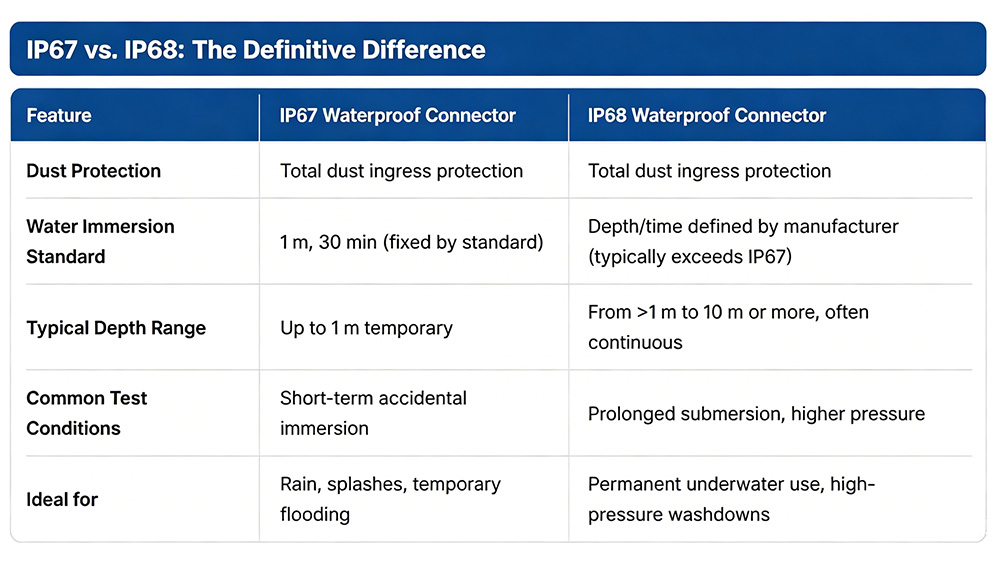 Un conector impermeable IP67 está diseñado para sobrevivir al tipo de empapamiento que esperarías al aire libre: una lluvia intensa, una breve inmersión en un charco o un lavado con una manguera de baja presión. Cuando el agua se retira, el conector permanece seco por dentro.
Un conector impermeable IP68 va un paso más allá. Está diseñado para una inmersión prolongada bajo las condiciones que el fabricante especifica explícitamente. Esto podría significar permanecer en el fondo de un tanque de agua, sellar cámaras submarinas o soportar la presión constante sobre el casco de un barco. Si tu aplicación mantiene el conector permanentemente mojado, IP67 simplemente no está clasificado para ese trabajo.
Escenarios de aplicación en el mundo real
Para hacerlo más tangible, veamos dónde encaja naturalmente cada clasificación.
Cuándo es la opción adecuada IP67
Iluminación LED y señalización para exteriores: Los conectores se enfrentan a lluvia, nieve y charcos ocasionales, pero no están continuamente bajo el agua.
Sensores agrícolas y controladores de riego: Las cajas de conexiones enterradas pueden inundarse temporalmente después de lluvias intensas; IP67 las mantiene operativas.
Conexiones auxiliares para automóviles y vehículos recreativos: Los arneses bajo el capó, enchufes de remolque y cámaras exteriores encuentran salpicaduras y rocío de la carretera.
Equipos industriales portátiles: Herramientas e instrumentos portátiles usados en exteriores que podrían caer al agua brevemente.
Electrónica de consumo: Bombas de jardín, equipos de camping y altavoces exteriores que pueden soportar una tormenta.
Para todas estas situaciones, los conectores impermeables IP67 ofrecen el equilibrio perfecto entre un sellado ambiental fiable y rentabilidad. Obtienes una protección real contra el agua sin sobredimensionar la solución.
Cuándo IP68 es imprescindible
Equipos marinos y submarinos: Bombas de achique, transductores de sonar, drones submarinos y cajas de conexiones sumergidas.
Plantas de tratamiento de agua y aguas residuales: Los conectores pueden permanecer en pozos húmedos o estar sometidos diariamente a chorros de limpieza a alta presión.
Instrumentos geotécnicos e hidrológicos: Piezómetros y sensores de nivel instalados permanentemente por debajo del nivel freático.
Procesamiento de alimentos y bebidas: Equipos sometidos a rigurosos lavados a alta temperatura y presión, a menudo combinados con requisitos específicos de resistencia química.
Energía marina y renovable: Conectores submarinos en turbinas mareomotrices o plataformas petrolíferas que deben sobrevivir durante años a profundidades importantes.
Aquí, especificar un conector impermeable IP68 no se trata de ir sobre seguro, sino de cumplir las exigencias fundamentales del entorno operativo. El costo de una falla a 5 metros bajo el agua es órdenes de magnitud mayor que la diferencia en el precio del conector.
Factores clave a considerar al elegir
Antes de asumir que “más alto es mejor”, revisa esta lista de verificación. Te ahorrará dinero y evitará volumen o complejidad innecesarios.
1. Exposición real al agua
Pregúntate honestamente: ¿este conector estará sumergido y, de ser así, durante cuánto tiempo y a qué profundidad? Un escenario de inundación repentina temporal requiere IP67. Una instalación permanente en una fuente requiere IP68 con parámetros de profundidad y tiempo claramente indicados.
2. Especificaciones de prueba del fabricante para IP68
Este es el paso que separa a un comprador bien informado de uno propenso a adivinar. Siempre revisa la hoja de datos. Un conector IP68 puede tener una especificación de “2 m / 24 h”, mientras que otro puede indicar “10 m / 500 h”. Si el fabricante no publica estos detalles, pregunta. Un sello “IP68” vago por sí solo no te dice lo suficiente.
3. Sellado con conexión y sin conexión
¿El conector debe ser impermeable solo cuando está completamente conectado o también cuando está desconectado y con una tapa protectora? Muchos conectores IP67 e IP68 solo alcanzan su clasificación cuando están conectados. Si tu aplicación implica desconexiones frecuentes en áreas húmedas, podrías necesitar tapas protectoras adicionales o un diseño de sellado diferente.
4. Integridad del cable y del conjunto
Un conector impermeable solo es tan resistente como el cable al que está conectado. La cubierta exterior del cable debe sellar correctamente con el prensaestopas o sobremolde del conector. Si realizas el ensamblaje en campo, presta mucha atención a los diámetros de cable recomendados y a los valores de par de apriete. Un conector IP68 correctamente especificado pero ensamblado de forma incorrecta seguirá teniendo fugas.
5. Exposición a temperatura y productos químicos
La profundidad del agua no lo es todo. El agua caliente, el vapor, los agentes de limpieza o la exposición a rayos UV pueden degradar los sellos con el tiempo. Si tu “agua” es una solución química, verifica la compatibilidad de materiales. Algunas líneas de conectores ofrecen sellos de silicona o EPDM clasificados para un amplio rango de temperaturas y una resistencia química específica, factores que importan tanto como el dígito IP.
6. Presupuesto y disponibilidad
Los conectores IP68 generalmente cuestan más debido a tolerancias más estrictas, juntas especializadas y pruebas individuales rigurosas. Si IP67 satisface tus necesidades, probablemente encontrarás una gama más amplia de opciones rentables y disponibles en tamaños de carcasa y configuraciones de contactos comunes. En compras por volumen, esta diferencia se acumula rápidamente.
Encontrar el conector que se adapta a su diseño
Al final del día, elegir entre conectores impermeables IP67 e IP68 no se trata de perseguir el número más alto. Se trata de adaptar la capacidad real comprobada del conector a las demandas específicas de su entorno. Para la mayoría de los equipos de exterior expuestos a lluvia, nieve y alguna inmersión accidental ocasional, un conector IP67 de calidad ofrece años de servicio sin problemas, sin el costo adicional ni el tamaño de una solución con una clasificación para aguas profundas innecesaria. Cuando la inmersión continua real entra en juego, un conector IP68 correctamente especificado se vuelve esencial, y la clave es leer más allá de la etiqueta para conocer la profundidad y la duración para las que realmente fue verificado.
Diseñamos una amplia cartera de conectores circulares impermeables en configuraciones IP67 e IP68, con documentación de pruebas transparente para que pueda especificar con confianza. Ya sea que necesite conectores estándar M12 cableables en campo para una red de sensores industriales o conjuntos sobremoldeados personalizados para un instrumento marino de próxima generación, estamos aquí para ayudarle a tomar la decisión correcta.
¿Listo para elegir con claridad?
Explore nuestra selección de conectores impermeables IP67 e IP68, o póngase en contacto con nuestro equipo de soporte de ingeniería con sus requisitos de inmersión. Le ayudaremos a encontrar la combinación exacta, sin excesos ni compromisos.