Engineering Summary & Key Takeaways:
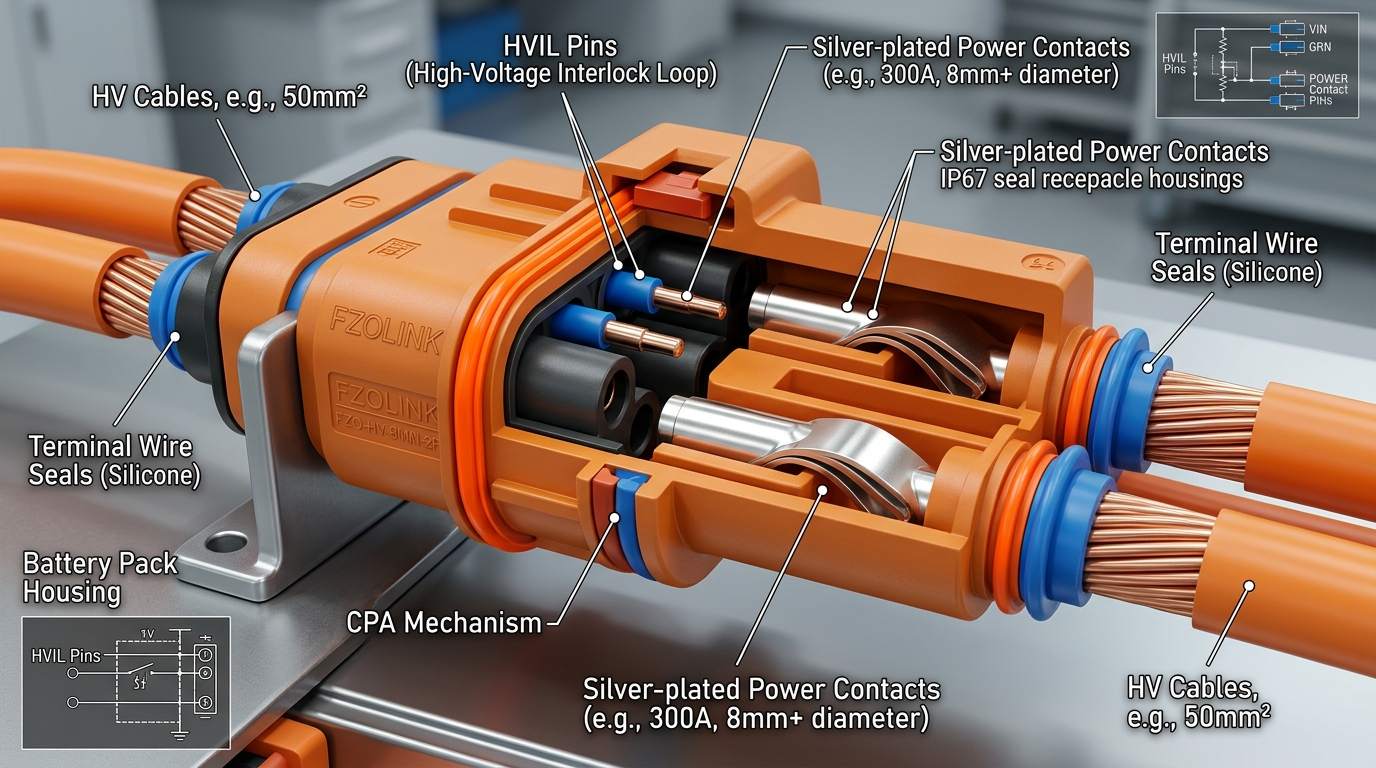
The shift toward global electrification rests entirely on our ability to store and distribute massive amounts of energy efficiently. Electric Vehicles (EVs) and Battery Energy Storage Systems (BESS) are the twin pillars of this green revolution. While automotive and energy headlines frequently highlight advancements in lithium-ion cell chemistry and solid-state batteries, the operational success of these multi-megawatt systems is dictated by a much smaller, yet equally critical component: the battery connector.
When a battery pack steps up to 800V architectures in modern EVs, or when a grid-scale BESS handles thousands of amps of continuous DC current, the margin for hardware error shrinks to zero. A poorly designed connector will create a bottleneck that strangles system efficiency, or worse, triggers a catastrophic thermal event. This comprehensive engineering guide examines the intricate design mechanics of modern battery connectors and how they directly influence the safety, efficiency, and longevity of high-voltage power storage networks.
1. Mastering Thermal Runaway Through Micro-Resistance Design
In any high-current application, the laws of physics are unforgiving. According to Joule’s Law, the heat generated in an electrical circuit increases with the square of the current ($P=I^2R$). When an EV is connected to a 350kW DC fast charger, hundreds of amps surge through the battery connectors within minutes. If the connection interface possesses even a fraction of a milliohm of excess resistance, it will generate intense localized heat.
In a tightly packed battery enclosure, this heat cannot easily escape. It transfers directly into the battery cells, degrading their lifespan and potentially initiating thermal runaway—a dangerous chain reaction where the battery rapidly catches fire. To combat this, premium high-voltage EV battery connectors are engineered using highly conductive copper alloys coated in thick silver plating. Furthermore, they employ multi-point spring contact technologies (such as crown bands or leaf springs) that maximize the microscopic surface area between the plug and receptacle, guaranteeing an ultra-low contact resistance that stays cool even under maximum charging loads.
2. High Voltage Interlock Loop (HVIL): The Ultimate Safety Mechanism
Handling 800V to 1500V DC power introduces severe lethal risks for assembly workers, maintenance technicians, and first responders. If a high-voltage connector is unplugged while the circuit is live (under load), it will draw a massive electrical arc through the air. This arc flash can reach temperatures hotter than the surface of the sun, vaporizing metal and causing fatal injuries.
To eliminate this risk, advanced battery connectors integrate a High Voltage Interlock Loop (HVIL). The HVIL is a low-voltage safety circuit routed through secondary, shorter pins within the same connector housing. Because the HVIL pins are shorter than the main power pins, they break contact first when the connector is pulled apart. This instantaneous break signals the central Battery Management System (BMS) to open the main contactors and kill the high-voltage power in milliseconds—long before the main power pins physically separate. This ingenious design completely prevents arc flashing and ensures that the exposed terminals are "dead" and safe to touch.
3. Defending Against Dynamic Mechanical Stress in E-Mobility
Stationary energy storage is one challenge; deploying batteries in a moving vehicle is entirely another. Electric vehicles are subjected to relentless harmonic vibration from the road, severe pothole shocks, and extreme G-forces during acceleration and braking. If a battery connector relies on rigid, static contacts, this vibration will cause microscopic rubbing (fretting) between the pins.
Fretting quickly wears away the silver plating, exposing the copper to oxidation and skyrocketing the electrical resistance. EV connector design solves this by utilizing dynamic spring-loaded terminals that independently adjust to micro-movements, maintaining constant, high-pressure contact regardless of chassis vibration. Additionally, these connectors are paired with heavy-duty energy storage cable assemblies that feature robust strain relief boots and corrugated shielding to prevent mechanical fatigue from transferring from the heavy gauge wires to the connector joints.
4. Environmental Sealing for Grid-Scale BESS Installations
Utility-scale Battery Energy Storage Systems (BESS) are primarily deployed outdoors, often housed in modified shipping containers near solar farms or coastal wind turbines. The external power linkages bridging the battery modules to the grid inverters are brutally exposed to UV radiation, heavy rain, and corrosive salt fog.
Moisture ingress in a 1500V system results in immediate catastrophic short circuits. To ensure 25-year outdoor reliability, modern energy storage architectures rely on IP68 sealed waterproof industrial enclosures and receptacles. These components utilize specialized fluorosilicone O-rings that do not degrade under thermal shock, and housings molded from UL94-V0 flame-retardant thermoplastics. This creates a hermetic seal that isolates the massive DC power flow from all environmental contaminants.
Application Matrix: EV Battery Connectors vs. Stationary BESS Connectors
|
Design Requirement
|
Electric Vehicles (E-Mobility)
|
Stationary Energy Storage (BESS)
|
|
Mechanical Stress
|
Extreme continuous vibration and shock; requires dynamic spring contacts.
|
Static installation; focuses more on robust locking and weight support.
|
|
Thermal Dynamics
|
Massive heat spikes during 15-minute DC fast charging sessions.
|
Continuous, steady heat generation during prolonged grid discharging.
|
|
Safety Integration
|
HVIL (High Voltage Interlock Loop) is strictly mandatory for crash safety.
|
Touch-proof (IP2X) finger-safe designs to protect maintenance crews.
|
|
Environmental Sealing
|
IP67/IP6K9K to survive high-pressure undercarriage washing and road salt.
|
IP68 for long-term outdoor weather, UV, and humidity resistance.
|
Frequently Asked Questions (FAQ)
How does battery connector design prevent thermal runaway in EVs?
Battery connectors prevent thermal runaway by utilizing thick, silver-plated copper alloy contacts that maximize surface area. This guarantees ultra-low contact resistance, allowing the connector to rapidly dissipate the intense Joule heating generated during rapid DC fast charging.
What is a High Voltage Interlock Loop (HVIL) in a battery connector?
An HVIL is a critical safety circuit built into high-voltage connectors. It uses shorter, secondary signal pins that disconnect before the main power pins do if the connector is unplugged. This signals the system controller to instantly cut power, preventing lethal electrical arcs and protecting the operator.
Why do stationary energy storage connectors need IP68 ratings?
Utility-scale Battery Energy Storage Systems (BESS) are often housed in outdoor shipping containers. IP68-rated connectors protect the high-voltage linkages from relentless rain, humidity, and salt fog, preventing moisture-induced short circuits and galvanic corrosion.
Engineering the backbone of the renewable energy grid requires uncompromising component safety and thermal reliability. At Xiamen Olink, we specialize in manufacturing cutting-edge high-voltage battery connectors, HVIL-integrated power interfaces, and IP68 custom cable assemblies designed for next-generation EVs and utility-scale energy storage. Partner with our technical team today to ensure your power architecture operates at peak performance.